
Smoke alarms and carbon monoxide (CO) alarms are among the most important life-safety devices installed in a home. Proper location, installation, power supply, interconnection, and maintenance can provide occupants with critical early warning of a fire or dangerous carbon monoxide condition.
For residential building code inspections throughout Dallas, Fort Worth, Ellis County, Dallas County, Collin County, and the greater DFW Metroplex, smoke and carbon monoxide alarm compliance should be evaluated as an important component of the home’s overall life-safety provisions.
The International Residential Code (IRC) addresses smoke alarms under Section R314 and carbon monoxide alarms under Section R315. Requirements can vary depending on the locally adopted code edition, amendments, age of the dwelling, and whether construction, additions, alterations, or repairs have occurred.
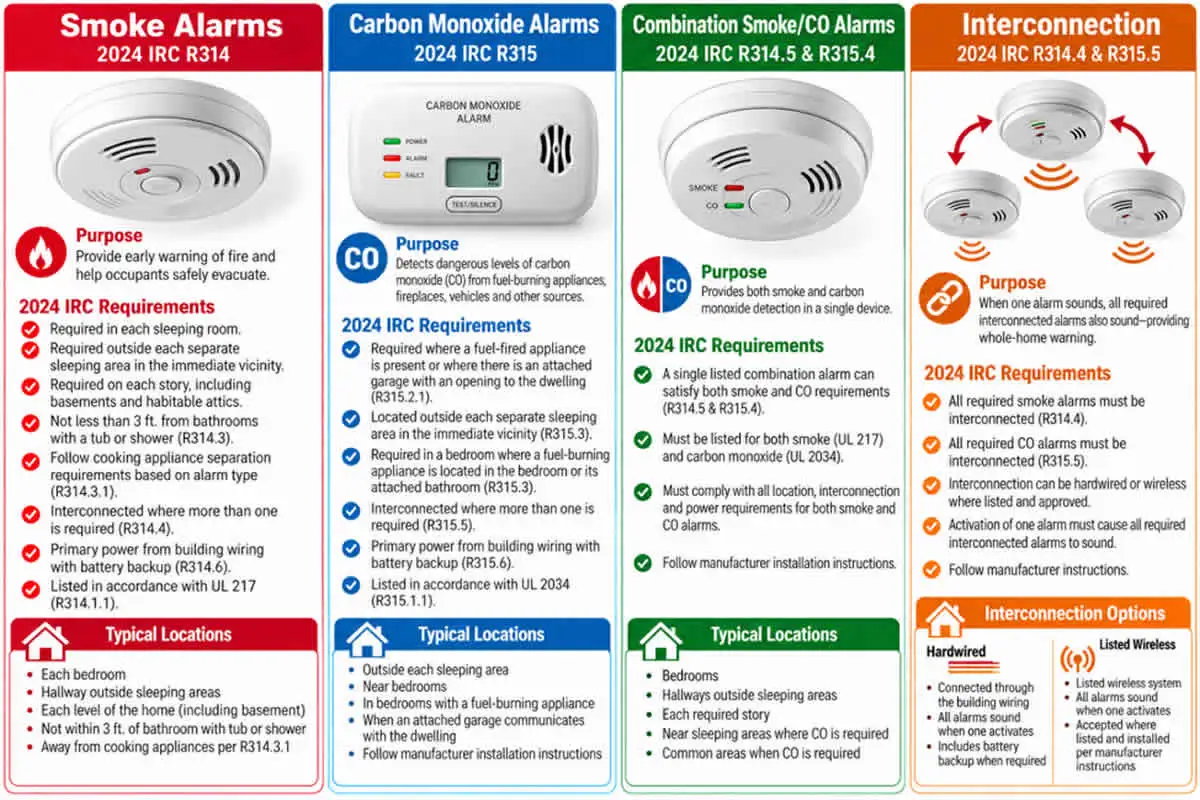
A smoke alarm is a life-safety device designed to detect products associated with a developing fire and provide an audible warning to occupants.
Its primary purpose is early notification. A fire can develop rapidly, and occupants—particularly those who are sleeping—may not see or smell smoke soon enough to safely escape.
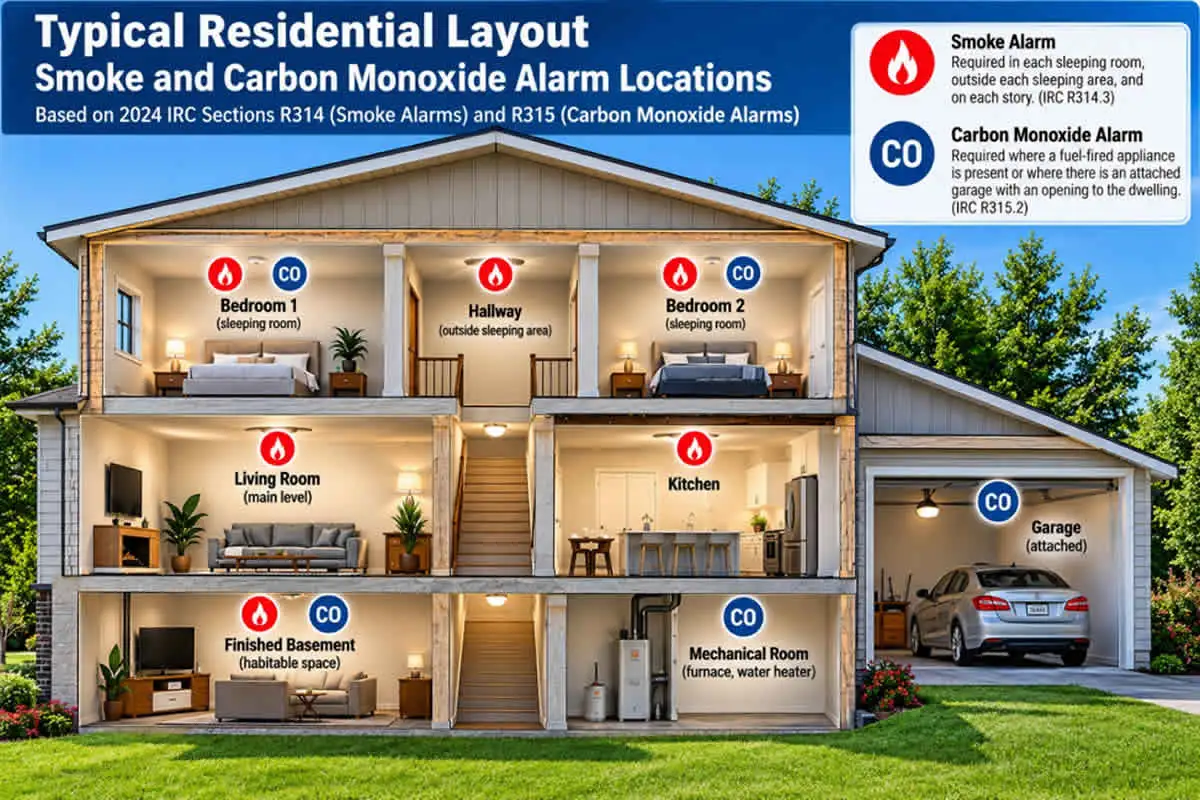
Smoke alarms are generally required:
Smoke alarms must also comply with applicable separation requirements from cooking appliances and bathrooms containing tubs or showers.
Carbon monoxide (CO) is a colorless and odorless gas that can be produced by incomplete combustion of fuels.
Potential residential sources can include gas-fired furnaces, water heaters, fireplaces, ranges, boilers, generators, and other fuel-burning appliances or equipment. Attached garages can also introduce a potential source of carbon monoxide from motor vehicles and other fuel-powered equipment.
Unlike smoke, carbon monoxide generally cannot be detected by sight or smell. This makes a properly installed and operational carbon monoxide alarm particularly important.
Under IRC Section R315, carbon monoxide alarms are required in new dwelling units where the dwelling contains a fuel-fired appliance or has an attached garage with an opening that communicates with the dwelling.
Required CO alarms are installed outside each separate sleeping area in the immediate vicinity of the bedrooms.
Where a fuel-burning appliance is located within a bedroom or its attached bathroom, a carbon monoxide alarm is also required within that bedroom.
Requirements for existing homes undergoing alterations, repairs, or additions should be evaluated separately because specific exceptions may apply.
Combination alarms can simplify installation while providing detection for two distinctly different hazards:
Smoke detection provides warning of conditions associated with a fire.
Carbon monoxide detection provides warning when dangerous concentrations of CO are detected.
The IRC specifically permits listed combination smoke and carbon monoxide alarms to be used where the applicable smoke and CO alarm requirements are satisfied.
For residential applications, combination alarms must carry the appropriate listings for both functions.
One of the most important features of a modern residential alarm system is interconnectivity.
Under IRC Sections R314.4 and R315.5, where multiple alarms are required within an individual dwelling unit, applicable alarms are generally required to be interconnected so that activation of one required alarm causes the interconnected alarms throughout the dwelling to sound.
This is particularly important in larger or multistory homes.
A fire beginning downstairs, in another bedroom, or on the opposite side of a house may otherwise go unnoticed by a sleeping occupant. An interconnected system provides warning throughout the dwelling rather than only at the location where the hazard is initially detected.
Interconnection does not necessarily require physical wiring between every alarm. The IRC recognizes listed wireless interconnected alarms where activation of one alarm causes the other required alarms to sound.
Existing dwellings and certain alterations may be subject to specific exceptions, so the applicable adopted code and circumstances should always be verified.
For new construction, IRC provisions generally require smoke and carbon monoxide alarms to receive their primary power from the building’s electrical wiring, with battery backup when primary power is interrupted.
The electrical connection is intended to provide a dependable primary source of power, while the battery provides protection during a power outage.
This is why removing a battery from a hardwired alarm can still compromise an important component of the home’s life-safety system.
A simple six-month alarm check is an excellent household safety routine.
At least every six months, homeowners should visually inspect their smoke and CO alarms, verify that they have not been damaged or obstructed, and check the condition of replaceable batteries.
However, a six-month check should not replace the manufacturer’s required testing schedule. Alarms should be tested using the manufacturer’s test procedure at the recommended interval. Batteries should be replaced whenever a low-battery warning occurs and according to the alarm manufacturer’s instructions.
Many newer alarms use sealed, long-life batteries that are not intended to be routinely removed or replaced. When these units reach the end of their service life or indicate replacement is necessary, the entire alarm is typically replaced.
Never remove or disconnect an alarm battery simply to silence a nuisance alarm.
Smoke and carbon monoxide alarms should not be treated as minor accessories or simply another item on an inspection checklist.
Their purpose is to provide occupants with time to recognize a dangerous condition and respond.
Missing alarms, incorrect locations, disconnected alarms, dead batteries, expired units, lack of required interconnection, and incomplete installations are conditions commonly identified during residential building code and final inspections.
Art Neidich Property Inspection & Consulting, a division of Lone Star Building Inspection, Inc., provides professional residential building code observation, inspection, and reporting services throughout the Dallas–Fort Worth Metroplex and surrounding North Texas communities.
Services include review and documentation of residential life-safety components such as:
Our services are focused on building code, construction, lender, municipal, builder, and institutional inspection needs and are not marketed as traditional buyer or seller home inspections.
Addresses smoke-alarm installation, required locations, interconnection, combination alarms, and power sources.
Addresses when CO alarms are required, required locations, combination alarms, interconnectivity, and power sources.
Applicable requirements should always be verified against the code edition and local amendments adopted by the authority having jurisdiction (AHJ).
Properly installed and maintained smoke and carbon monoxide alarms are a fundamental part of residential life safety.
Art Neidich Property Inspection & Consulting provides experienced residential building code inspection and compliance reporting throughout Dallas–Fort Worth and surrounding North Texas communities, with an emphasis on accurate observations, clear documentation, and applicable code requirements.