The task of Property Condition Observation and Reporting refers to understanding the external physical condition of the property, commercial or multifamily being the type of properties that can be analyzed with this method. Usually, the process of Condition Observations is unobtrusive, includes the ground, building, roof, main systems without limited to HVAC and plumbing, and inner parts of the object. As a result, there is the so-called report about the property condition. It outlines all visible problems, remaining time of important components and their repair costs. Both buyers and lenders have to consider this data when making the decision about investment.
Honestly, nobody buys a whole apartment complex just because the lobby looks nice. But more often than you’d expect, deals happen after glancing at the rent roll and doing a quick walk-through with the maintenance guy. Then, the issues—roofs, old boilers, crumbling parking lots—turn into unexpected bills down the road.
Up ahead, I’ll explain what goes into one of these assessments, what the final report actually covers, how it’s not quite the same as a home inspection, and how to make sense of the report—even if you’re not an expert.
What Property Condition Observation and Reporting Covers
Property Condition Observation and Reporting documents a building’s visible physical condition using an established assessment standard. The main one people follow is ASTM E2018. It lays out the basics: someone does a walk-through, talks to the staff, looks over any documents they can get, and then writes up what repairs might cost. Everything is done visually. The assessor doesn’t open up walls or run heavy tests—just what they can see or gather from talking and reading.
What’s inside a property condition report
The property condition report is the deliverable you actually keep. The cost tables are the part most readers should open first. These issues usually fall into two categories.
Immediate repairs are those that are required within a year of closing the sale, such as fixing the handrail or the roof. The next category is replacement reserves, which are used to cover the replacements of large home systems and components, including HVAC equipment, and roof materials. This type of repair is usually spread over a ten to twelve-year period, depending on what the lender wishes to see.
Each issue gets a photo as proof. A good report also spells out its limits—where inspectors couldn’t go, paperwork they asked for but never got, or equipment they didn’t test. Sometimes you’ll hear people talk about a capital needs assessment. It lines up pretty closely with a PCA.
Property Condition Observation and Reporting vs. Home Inspection
A home inspection is pretty straightforward. It’s for a single-family house, ordered by the buyer, and almost always leads to a back-and-forth repair. PCAs, on the other hand, focus on commercial or multifamily buildings, follow a standard format, and turn everything into cost estimates. All three share field methods. They differ in who reads the result and what they do with it.
Who Needs Property Condition Observation and Reporting, and When?
- Buyers during due diligence. The assessment prices the physical risk before the inspection period ends.
- Lenders on acquisitions and refinances. Agency multifamily lenders such as Fannie Mae and Freddie Mac typically require one.
- Insurers and underwriters. They use it to judge risk on older or larger buildings.
- Investors and portfolio owners. They order it to plan capital spending across properties.
We provide Property Condition Observation and Reporting services for lenders and investors, including documentation of rental property conditions, alongside our FHA compliance and building code inspection services.
What Property Condition Observation and Reporting Won’t Tell You
A PCA isn’t a code compliance review, and it won’t find what’s hidden behind finished walls. It also doesn’t replace an environmental site assessment, which is a separate study. And it’s not a guarantee. It’s a trained opinion about visible conditions on one day.
How to read a property condition report in ten minutes
- Open the immediate repairs table and add up the total.
- Check the reserve schedule and find the years with the biggest spikes.
- Read the limitations page. What wasn’t accessed?
- Scan the photos attached to the largest dollar items.
- Call the assessor and ask what worried them but didn’t make the report.
Most people read these reports from front to back. We think that’s backwards. The money is at the back.
Adding a measured baseline to the report
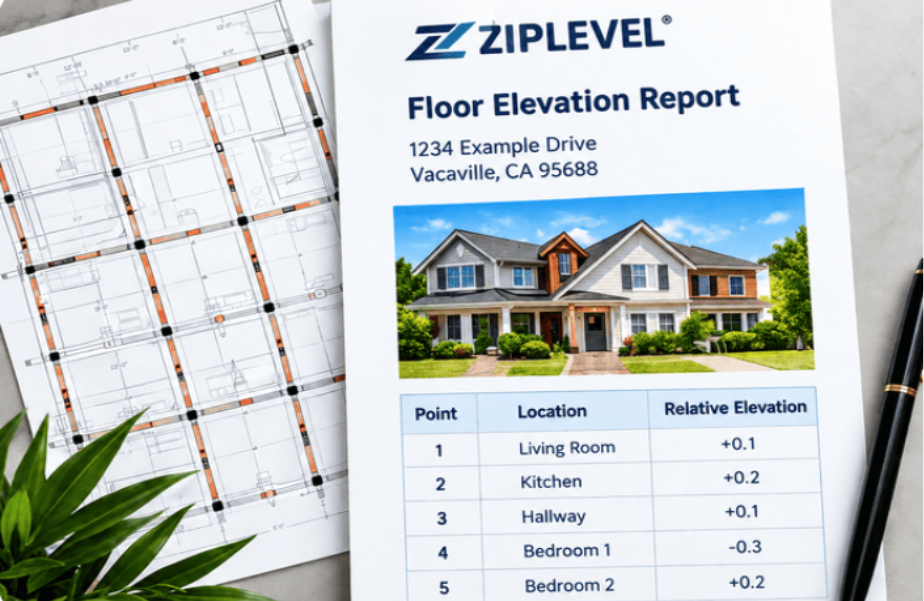
A PCA is visually designed. It can tell you a floor looks uneven, but it can’t hand you a number to track. That’s where a dated floor elevation record helps. Our ZIPLEVEL® service measures relative floor elevations in tenths of an inch. Pairing property condition observations and reporting with a baseline reading gives future reviewers concrete data for comparison.
To be clear, ZIPLEVEL® is elevation documentation only. It doesn’t replace the PCA, and it isn’t an engineering evaluation.
How long it takes and what affects the price
Field time varies according to size. A small commercial building may take a couple of hours onsite while a multi-building apartment community will take days. The report delivery may also take anything from a few days to a couple of weeks depending on building size and complexity as well as pace of information gathering from the property owner. Pricing depends on the scope, number of buildings and apartments, and lender requirements.
Order it while you can still walk away
The best time to arrange Property Condition Observation and Reporting is before you’re financially committed to the property.
Frequently Asked Questions
What is Property Condition Observation and Reporting?
Property Condition Observation and Reporting documents the visible physical condition of a commercial or multifamily property. The resulting report typically includes observations, photographs, and estimated repair or replacement costs.
How is a PCA different from a home inspection?
So, what sets a PCA apart from a home inspection? A home inspection is for buyers looking at single-family homes. A PCA, on the other hand, is for commercial or multifamily properties, and it’s not just for buyers—it also helps lenders and property owners. Instead of just listing problems, a PCA breaks everything down into costs and timelines.
How long is a property condition report good for?
These reports don’t really have an expiration date. Lenders usually ask for something current, so just make sure you check their rules before ordering one.
Does a PCA include environmental testing?
No. Environmental questions fall under a separate study, usually called an environmental site assessment. A PCA only covers the physical condition of the property.